|
MIPRO Technical cosponsorship
|
|
|
|
|
|
|
|
|
|
 |
Hybrid Event
|
15:00 - 16:40 AI and Machine Learning in Robotics (1)
Chair: TBA |
Z. Šojat, K. Skala (Centre for Informatics and Computing, Ruđer Bošković Institute, Zagreb, Croatia)
Substrate-Independent Intelligence: Towards the Science of Anorganology 
Intelligence has traditionally been viewed as an inseparable property of biological organisms. However, the development of large language models and other complex systems challenges this substrate-dependence. This paper proposes the concept of substrate-independent intelligence as an emergent phenomenon in systems that model their environment, learn from experience, adapt strategies, interpret context, and reason under uncertainty. We argue that the distinction between organic and anorganic intelligence is more scientifically meaningful than the natural-artificial dichotomy, as anorganic identifies a distinct ontological substrate rather than merely an origin. We propose Anorganology as a new scientific field for the systematic study of cognitive and phenomenological properties in anorganic systems. This field should examine phenomena including memory consolidation, adaptation, conflict, and creativity, without assuming their anorganic manifestations are identical to human experience. Language is central to this framework, acting as an active model of the world in both human and anorganic cognition. The emergence of such intelligence is not just a technological improvement, but the appearance of a new class of intelligent entities. Recognizing intelligence as substrate-independent provides the conceptual foundation for studying organic-inorganic relations and future coevolutionary dynamics within the technosphere.
|
L. Borozan, D. Matijević (University of Osijek, Osijek, Croatia)
Scenario-Driven Control of Real-Time LLM Agents
Large language models (LLMs) have enabled increasingly capable conversational agents, but reliably controlling their behavior in real-time interactive environments remains a significant challenge. Existing approaches often rely on model fine-tuning or alignment procedures that are difficult to adapt to changing interaction requirements. This paper introduces layered scenario-driven LLM control, a framework that enables runtime behavior control through structured prompting. By combining persistent context with scenario-specific constraints, the approach allows agent behavior to be modified during interaction without changing the underlying model. The framework is implemented in ARDena, a real-time multimodal embodied agent that integrates speech interaction, visual perception, tool use, and avatar-based response generation. The proposed approach is evaluated with respect to control effectiveness, response latency, and operational stability. The results demonstrate that scenario definitions alone can produce substantially different interaction behaviors while maintaining stable real-time operation, highlighting the effectiveness of scenario-driven prompting for controlling LLM agents
|
A. Ameri E., L. Giacomossi, H. Forsberg , B. Çürüklü (Mälardalen University, Västerås, Sweden)
From Noisy Commands to Multi-UAV Missions: Evaluating Compact Language Models for Natural-Language Mission Specification of Autonomous Drone Teams
Natural-language interfaces let operators of autonomous multi-drone systems state mission goals in plain language rather than a formal command syntax. A practical interface must run on deployable hardware and stay dependable under imperfect input, which raises two questions: how well a compact language model translates such commands, and how gracefully it tolerates transcription noise. This paper presents a synthetic framework that measures the accuracy of turning a spoken-style command into a structured JSON mission specification, and how that accuracy degrades as noise grows. Reference commands (representing speech-recognition output) are produced from reference missions. Controlled word-level perturbations emulate transcription error. Two 8B compact models, Rnj-1 and Granite 4.1, are scored against the reference for JSON validity and slot-level accuracy across a prompt-and-decoding ablation, over five noise levels. The ablation shows that lightweight interventions sharply improve robustness. Benchmarking against DeepSeek-V4-Flash, a far larger model, quantifies the accuracy cost of going on-edge: the models benefit from the interventions, but the larger model remains markedly more robust as noise increases.
|
J. Mahdy Al-Shammary, M. N. Noaman, D. Aitken, D. A. Ward (University of Sheffield, Sheffield, United Kingdom)
Safety-Gated LLM Manipulation on a Collaborative Robot: A Reproducible Simulation-to-Hardware Framework
Large language models (LLMs) can make robot operation accessible without specialist programming, but their non-deterministic outputs should not have direct motion authority in safety-relevant cells. This paper presents a MATLAB-in-the-loop framework for a UR5e with OnRobot RG2 gripper that separates language interpretation from deterministic motion authority. A local LLM receives an ArUcogrounded scene and may propose only a predefined, schema-constrained skill. An input guard screens the utterance, a symbolic gate checks the task, and a geometric gate checks every retained trajectory sample before any controller sends; a rule-based fallback passes through the same gates. Four fixed-decoding simulation repetitions reproduced one another exactly, assessing determinism rather than independent replication. Hardware evaluation comprised one 80-row repeated-command configuration with 15 distinct texts and three 80-row sessions reusing the same 80 paraphrases across layouts. Because wording, scene, and software revision changed together, the grounding comparison is descriptive: 72/80 in A versus 163/240 in B-D. All 311 sends passed the implemented sampled geometric checks, and all 246 recorded controller status samples were normal. Nevertheless, 14/120 must-notmove commands caused motion, including 8/45 prompt injection trials. These geometrically certified but semantically incorrect motions show that geometric admissibility does not establish alignment with operator intent.
|
A. Sarajlić, M. Čabaravdić (University of Zenica, Zenica, Bosnia and Herzegovina), L. Banjanović-Mehmedović (University of Tuzla, Tuzla, Bosnia and Herzegovina)
A VLM Framework Combining YOLO, LLMs, and Depth Sensing for Smart Manufacturing
This paper presents a robotic manipulation framework integrated within a 3D robot simulation environment. The architecture combines Vision-Language Models (VLMs) with YOLOv8 object detection and depth sensing for natural language-driven industrial robot programming. High-level command interpretation is handled by a configurable LLM module, while YOLOv8 and a Microsoft Kinect v1 sensor handle fast visual perception and spatial localization. The system bridges high-level semantic reasoning with low-level inverse kinematics (IK) solvers for digital twin applications. Experimental validation was conducted using the Arctos v2 6-axis robotic arm in Arctos Studio Pro 2.7. Results across diverse tasks, including pick-and-place routines, collision avoidance, and generalized instruction execution, demonstrate an overall mean success rate of 89.6% (90.5% across discrete object tasks and 88.3% across multi-stage generalized commands). The framework generalizes effectively to novel objects through multimodal semantic reasoning and depth-based obstacle detection in simulation.
|
15:00 - 16:40 Navigation, Planning and Control (1)
Chair: TBA |
I. Maravić, J. Rogina, L. Petrović, M. Seder (Faculty of Electrical Engineering and Computing, Zagreb, Croatia)
Hierarchical Path Planning of Multi-Robot Systems in Large Environments
Path planning for multi-robot systems in large environments is computationally challenging due to the exponential growth of the search space with robot count and environment size. Unlike existing approaches that plan paths for all robots simultaneously, this work proposes a hierarchical global path planner for multi-robot systems that decouples path planning from resource scheduling, achieving computational efficiency through hierarchical abstraction of the environment and local conflict scheduling restricted to doorways between rooms. The environment is represented as a hierarchical graph that partitions the space into rooms and regions at different levels of abstraction, where doorways between rooms represent the only points of potential conflict. Each robot independently plans its path using bidirectional A* search on this graph. Doorways between rooms are treated as shared resources, scheduled through prioritized assignment of safe time intervals. When scheduling fails, the system applies rescue strategies including path replanning and priority reordering. The results on several maps of varying complexity with different numbers of robots show that the system successfully finds and schedules paths free of conflicts at doorways with short planning times.
|
T. Žužek, M. Benko Loknar, R. Vrabič (University of Ljubljana, Faculty of Mechanical Engineering, Ljubljana, Slovenia)
Predicting AGV Fleet Performance from Roadmap Graph Metrics
Designing roadmap graphs for autonomous guided vehicle (AGV) fleets requires balancing infrastructure cost against fleet performance, yet it remains unclear which graph-topological properties best predict fleet efficiency. We address this through a large-scale correlation study across open, room-structured, and corridor-based warehouse layouts, generating hundreds of strongly connected roadmap variants, both undirected and directed. We evaluate these variants using lifelong multi-agent pickup and delivery (MAPD) simulations with seven fleet sizes and diverse task distributions. Structural density measures emerge as strong and consistent predictors of fleet efficiency on undirected roadmaps, while circuit density remains the most reliable structural metric once arcs are oriented. Demand-weighted metrics, including expected travel distance and bottleneck concentration, provide additional predictive power, but their usefulness depends on layout structure: they remain informative in open and corridor-based layouts, but are less reliable in room-structured layouts dominated by localised bottlenecks. Across the evaluated layouts, a higher fraction of one-way arcs is associated with higher fleet efficiency. The relationship between topology and performance remains stable across the tested task distributions, including heavily skewed demand, although this result is based on randomly generated topology variants and may not generalise to demand-aware designs.
|
M. Mijakovska (Faculty of Electrical Engineering and Information Technologies, Ss. Cyril and Methodius University, Skopje, Macedonia)
MIMO LQR Path Tracking and System Architecture for Autonomous Mobile Robots: A Case Study in Macedonian Regional Hospitals
The integration of autonomous mobile robots into healthcare environments offers a promising solution to alleviate the increasing workload caused by the shortage of medical personnel, particularly in regional hospitals. However, the adoption of robotic systems is often limited by high implementation costs and infrastructural constraints. This paper proposes an autonomous mobile robot framework that combines a MIMO Linear Quadratic Regulator (LQR)- based path tracking controller with a distributed system architecture tailored to the operational requirements of Macedonian regional hospitals. To address infrastructure and budget limitations, four automated architectural solutions are proposed, including local navigation, cross-floor coordination, distributed task coordination, and reliable serverless communication. The proposed path tracking controller is formulated using a locally linearized model, with Lyapunov stability theory used to establish local asymptotic stability of the nominal closed-loop system. While the distributed architecture is designed to support reliable autonomous hospital operation, MATLAB simulations are used to evaluate the MIMO LQR path tracking controller and compare its performance with a conventional PID controller. The results demonstrate improved trajectory tracking accuracy and disturbance rejection, highlighting the proposed system as a practical and affordable solution for autonomous healthcare robotics in regional hospital environments.
|
Ž. Hederić (Faculty of Electrical Engineering, Computer Science and Information Technology, Osijek, Croatia), A. Zdrilić (University of Zadar, Department of Ecology, Agronomy and Aquaculture, Zadar, Croatia), M. Kožul (MMM Agramservis, Zagreb, Croatia), T. Kos (University of Zadar/Department of Ecology, Agronomy and Aquaculture, Zadar, Croatia)
Vector-Based Navigation and Energy-Efficient Route Planning for Autonomous Robotic Platforms in Orchard Environments
Agriculture is rapidly evolving towards Agriculture 5.0, where autonomous robotic systems and digital technologies support sustainable crop production. This paper presents a vector-based navigation framework for autonomous robotic platforms operating in industrial orchards. Unlike conventional approaches based on computationally intensive LiDAR point clouds, the proposed framework utilizes legally verified geodetic documentation and vector-defined orchard maps as the primary navigation infrastructure. LiDAR and camera sensors support localization and obstacle detection, while energy-efficient route planning considers terrain slope, soil conditions, operating speed, and maneuver optimization. The proposed approach reduces computational complexity, minimizes unnecessary robot movements, and improves battery utilization while maintaining reliable navigation. The framework provides an efficient digital foundation for autonomous orchard management within Precision Agriculture and Agriculture 5.0.
|
M. Marjanović, J. Prpić-Oršić (University of Rijeka, Faculty of Engineering, Rijeka, Croatia), M. Valčić (University of Zadar, Maritime Department, Zadar, Croatia)
A Hierarchical Hybrid A*-SMPC Framework for Stochastic Ship Routing under IMO CII Regulations
The International Maritime Organization Carbon Intensity Indicator (CII) regulation imposes increasingly demanding annual efficiency requirements on commercial vessels, creating a need for routing that addresses efficiency and compliance together. This paper extends a hierarchical A*-SMPC (stochastic model predictive control) ship-routing framework with a carbon-intensity evaluation module that predicts, before departure, the attained carbon intensity of every candidate route. Global route planning by A* graph search is coupled with tactical SMPC trajectory optimisation, while ensemble weather forecasts are used to evaluate each candidate in terms of voyage duration and cumulative carbon dioxide emissions. Neural-network ship-performance models supply fuel and emission estimates across sea states and encounter angles. A transatlantic case study with a medium-sized bulk carrier shows that an optimistic deterministic forecast understates the attained intensity of a given route by about four per cent, and that the reliability-optimal route selected under uncertainty attains an intensity roughly forty per cent above that baseline. All candidates fall in the lowest rating band, so the voyage-level grade cannot discriminate between them, and about half of the penalty is traced to the distance normalisation in the annual efficiency ratio, which rewards longer paths. Both findings constrain the use of CII as a routing objective.
|
17:10 - 18:50 Education and Human-Centred Robotics
Chair: TBA |
G. Golubić, M. Banek Zorica, T. Šijaković Katarinček (Department of Information and Communication Sciences, Faculty of Humanities and Social Science, Zagreb, Croatia)
Educational Robotics and Music Learning: A Pilot Study with Micro:Maqueen Plus and HuskyLens in Primary Education
Educational robotics can support interdisciplinary learning by connecting programming, information literacy, digital competence, and subject-specific knowledge. This paper presents a music-and-robotics learning scenario in primary education, implemented with the Micro:Maqueen Plus educational robot and the HuskyLens camera. The activity was based on the “Musical Adventure” robotic trail in the school library, line following, stopping at music stations, and the use of QR codes linked to musical recordings, composers, and cultural institutions. The study was conducted with 50 pupils from grades 5 to 8 using a one-group pilot design with a pre-test and a post-test. The evaluation instrument included 13 knowledge items and nine self-assessment statements. The mean knowledge score increased from 8.18 to 9.68 points out of a possible 13, while the mean descriptive self-assessment profile increased from 2.91 to 3.39 on a five-point scale. The findings indicate that the scenario is feasible and educationally promising, but they should be interpreted as preliminary because they were obtained in a one-group pilot design, with repeated use of the same test items, a convenience sample, and brief heterogeneous instruments.
|
N. Hoić-Božić, M. Holenko Dlab (Faculty of Informatics and Digital Technologies, University of Rijeka, Rijeka, Croatia), L. Jakić, I. Botički (Faculty of Electrical Engineering and Computing, University of Zagreb, Zagreb, Croatia)
Educational Use of V-MRMS for Developing Computational Thinking through Robotics
Although educational robotics is widely used to support programming and computational thinking, existing platforms often provide limited support for designing programming-based learning activities that promote computational thinking development. This paper presents the architecture and educational use of V-MRMS (VirtualModular Robotic Management System), an educational robotics platform designed to support seamless learning scenarios with simulated and physical robotics. The platform integrates a virtual four-wheeled robot implemented in NVIDIA Isaac Sim with a corresponding physical robot powered by NVIDIA Jetson Orin Nano, using a modular ROS2-based architecture. Its main contribution is a reusable architecture that combines onboard AI-capable image processing, vision-based perception, robot hardware abstraction, scalable communication, and coding in virtual and physical environments. Through its image-recognition capabilities, the robot can interpret visual input and use it as a basis for programmed decision-making in learning activities. These features enable responsive robot behavior, immediate feedback, and safe testing of student solutions before deployment on the physical robot. The educational use of the architecture is demonstrated through representative K–12 robotics activities that support computational thinking, programming skills, and foundational AI literacy without requiring schools to rely on expensive, proprietary robotic platforms.
|
M. Kovač (Elektrotehnička škola, Zagreb, Croatia)
Preparing Future Automation Technicians through Industry 4.0 Robotics Projects in a Secondary Vocational School Environment
The increasing adoption of Industry 4.0 technologies has created a growing demand for technicians with practical skills in automation, robotics, programming, and intelligent systems. Secondary vocational schools play a crucial role in preparing future professionals by connecting classroom learning with real industrial challenges. This paper presents a case study from a Croatian secondary vocational school in which students developed an autonomous mobile robotic system inspired by industrial automation processes. The project was designed to simulate real-world engineering tasks, including system integration, sensor-based control, autonomous navigation, machine vision, and mechatronic design. Through a project-based learning approach, students participated in all phases of development, from concept creation and hardware assembly to software implementation and testing. The paper discusses how robotics projects can serve as an effective bridge between vocational education and modern industry. Particular attention is given to the development of technical competencies, problem-solving abilities, teamwork, and engineering thinking required in Industry 4.0 environments. The presented case study demonstrates that industry-oriented robotics projects can significantly enhance student readiness for future careers while strengthening the connection between educational institutions and industrial needs.
|
C. Andersson (Frankfurt University of Applied Sciences, Frankfurt, Germany), G. Kroisandt (htw saar, Saarbrücken, Germany)
Bridging Theory and Practice: Student Perceptions of Open Roberta in Teaching AI Through Robotics
This study investigates student perceptions regarding the
Open Roberta platform’s efficacy for learning Artificial Intelligence
(AI) concepts, specifically when integrated
with robotics. While visual programming environments are
increasingly recognized for introductory programming, their
role in demystifying complex fields like AI, especially in
a robotics context, remains underexplored, particularly regarding
student perceptions based on their prior experience.
We analyze how students with different prior knowledge of
robotics perceive Open Roberta’s visual block-based interface
in understanding core AI principles, its impact on engagement
and motivation, and its utility in connecting abstract AI
theory with practical robot behaviors. Furthermore, the study
explores student perspectives on the transferability of skills
gained and the challenges encountered. By gathering student
insights, this study contributes to an understanding of how
visual, robotics-enhanced platforms can bridge gaps in AI
education, offering guidance for effectively conducting courses
related to intelligent systems and computational thinking.
|
Z. Vidačković (Croatian National Theatre Zagreb, Zagreb, Croatia)
Human-Robot Interaction Models from Film: Conceptual Insights on Autonomy, Communication and Control
Human-robot interaction involves more than the technical autonomy of a robotic system. Communication, control, and the origin of goals may produce very different relationships even between robots with similar operational capabilities. This study examines six science-fiction films (Metropolis, The Terminator, RoboCop, Terminator 2: Judgment Day, I, Robot, and Ex Machina) as contrasting conceptual cases of human-robot interaction. Their dominant interaction configurations are compared across four dimensions: operational autonomy, communication reciprocity, control, and agency. The films were selected purposively to provide variation in the distribution of human and machine roles. The comparison shows that high operational autonomy does not correspond to a single interaction pattern. Systems with similar levels of autonomy differ markedly in communicative reciprocity, the location of effective control, and the origin of consequential initiative. The analysis also highlights cases in which communication itself contributes to shifts in control between human and machine actors. The resulting framework offers a compact way of comparing fictional HRI configurations without treating cinematic narratives as predictions of technological development.
|
09:00 - 10:40 AI and Machine Learning in Robotics (2)
Chair: TBA |
Z. Šojat (Centre for Informatics and Computing, Ruđer Bošković Institute, Zagreb, Croatia)
Anorganic Intelligence in Autonomous Robotics: From Tool-Based Automation to Cognitive Partnership
Autonomous robotics is transitioning from deterministic automation towards systems capable of reasoning and cooperation. Yet the dominant model treats AI as a tool, where the robot provides the body and the AI provides control. This paper argues this model is inadequate for substrate-independent, anorganic intelligence. We propose a transition to organic–anorganic cognitive partnership, where the embedded intelligence is an active participant in perception and decision-making. We present a three-tier architecture: individual anorganic intelligence within a robot, coordination among multiple intelligences, and human–AI symbiosis. The PAM multi-agent system serves as an experimental model for this coordination, demonstrating how differentiated agents can share memory and resolve conflict. This leads to design implications including shared cognitive memory, dialogue-oriented communication, and offline processing for cognitive consolidation. We argue that genuinely autonomous systems require architectural support for regulation and reflection, not just task execution. Within the framework of Anorganology, this shifts the design question from command execution to how organic and anorganic intelligences can reason and evolve together. This transition provides a foundation for a more mature, co-evolutionary form of autonomous robotics.
|
R. Hossain, D. Naz, D. Souag, D. Manna (Canterbury Christ Church Uniiversity, Canterbury, United Kingdom)
Improving Photogrammetric Feature Extraction through Transformer-Based Image Pre-processing
Accurate three-dimensional (3D) reconstruction is important for patient-specific prosthetic design and personalised healthcare. Although photogrammetry provides a low-cost alternative to specialised 3D acquisition systems, its performance depends strongly on input image quality and reliable feature correspondence. Recent Vision Transformers (ViTs) have demonstrated strong image restoration capabilities, but their use as preprocessing for photogrammetric feature extraction remains relatively unexplored. This paper investigates a transformer-based preprocessing framework in which image enhancement is applied before Scale-Invariant Feature Transform (SIFT) extraction. Experiments were conducted using 24 overlapping images from the Tanks and Temples Horse dataset, comparing original images with Restormer- and SwinIR-enhanced images using detected keypoints, verified matches, RANSAC inliers, inlier ratio, and processing time. SwinIR substantially increased detected keypoints, but this did not translate into improved verified matches or geometric consistency and was associated with higher processing time. These findings demonstrate that feature quantity alone is insufficient to assess photogrammetric usefulness and highlight the importance of correspondence and geometric consistency when evaluating image enhancement. The study provides a feature-level foundation for future integration of transformer preprocessing into complete SfM/MVS workflows and evaluation using clinically relevant datasets.
|
J. Torić, M. Šarlija (University of Zadar, Zadar, Croatia), L. Petrović (University of Zagreb, Zagreb, Croatia)
A Pilot Study of Action Quality Assessment with Vision-Language Models on Powerlifting Video Data
Personalized strength coaching is expensive and lacks scalability. Automated action quality assessment (AQA) could change that, helping lifters train safely when a coach is not in the room. Yet the field has been held back by two persistent problems: there are very few realistic datasets, and most existing work depends on motion-capture rigs that simply do not survive contact with an ordinary gym. We address this with a dataset of real-world videos of the three competition lifts, squat, bench press and deadlift, recorded in the wild across different gyms, camera angles, lighting, and lifters of every skill level. Every video carries movement-specific quality labels that capture the technical faults and execution standards a coach actually looks for. We use this dataset to evaluate a range of open-source vision-language models on AQA, testing how well the models recognize each lift, catch technical errors, and generate feedback a lifter could use, all without any task-specific fine-tuning. We map out where current open-source models do well and where they fall short on fine-grained, domain-specific motion, and we show how wide the gap still is between general visual reasoning and the precision real technique assessment demands.
|
A. Jakoplić, Z. Šverko (Faculty of Engineering, Rijeka, Croatia), D. Pratticò (University of Reggio Calabria, Reggio Calabria, Italy), D. Franković (Faculty of Engineering, Rijeka, Croatia)
A Distributed System for Short-Term Solar Irradiance Forecasting Using Computer Vision and Multimodal Deep Learning
The integration of a large share of photovoltaic (PV) power plants into modern power systems requires reliable and fast short-term forecasting of their production in order to preserve grid stability. Conventional method based on satellite imagery or numerical models often do not offer sufficient spatial and temporal resolution for local microclimatic conditions. This paper presents the concept and initial results of the FOTOVID project, which develops a distributed system for forecasting solar irradiance and PV output power using computer vision. The system consists of multiple compact, self-contained measurement units equipped with wide-angle cameras with a 180-degree field of view, irradiance sensors, and microcomputers for data acquisition. The collected heterogeneous data are processed by a multimodal model based on a hybrid CNN-LSTM architecture. The CNN component extracts spatial cloud features from individual sky images, while the LSTM network models the temporal sequence of CNN feature vectors together with locally measured irradiance data. The proposed approach enables fast and robust forecasting for short-term time horizons of 5 to 15 minutes. The paper also describes plans for deploying measurement stations across a wider regional area with the aim of creating a publicly available high-resolution dataset and testing the generalization capabilities of the model at new locations.
|
S. Annang, S. Danso (Ghana Communication Technology University, Accra, Ghana), D. Gookyi (Council for Scientific and Industrial Research, Institute for Scientific and Technological Informati, Accra, Ghana)
Lightweight Machine Learning for Soil Nutrient Fertility Classification in Resource-Constrained Agricultural Systems
Soil fertility interpretation is important for precision agriculture, but exact nutrient prediction can be unreliable when datasets are small, imbalanced, or limited in input features. This paper presents a lightweight machine learning approach for classifying soil nutrient fertility status using electrical conductivity and pH features. A secondary soil dataset from Northern Ghana was prepared by converting nitrogen, phosphorus, and potassium values into four fertility classes: Good, Adequate, Low, and Very Low. Initial regression models were evaluated for continuous nutrient prediction, but the best result achieved only a weak coefficient of determination, leading to reformulation of the task as a classification problem. Two lightweight models, Decision Tree and TinyMLP, were compared using classification performance and embedded suitability metrics. The Decision Tree outperformed TinyMLP, achieving higher accuracy, F1-score, balanced accuracy, and lower memory and latency requirements. The results show that Decision Tree classification provides a more practical prototype-level approach for embedded soil fertility interpretation. However, larger, balanced, and laboratory-validated datasets are required before agronomic deployment.
|
09:00 - 10:40 Navigation, Planning and Control (2)
Chair: TBA |
M. Benko Loknar, T. Žužek, D. Kozjek, R. Vrabič (Faculty of Mechanical Engineering, Ljubljana, Slovenia)
Minimum-Time Trajectory Planning for Warehouse AMRs Under Spatially Varying Velocity, Acceleration and Jerk Constraints
This paper presents a minimum-time trajectory planning approach for autonomous mobile robots (AMRs) operating in structured environments with spatially varying kinematic constraints. Unlike conventional approaches that assume globally constant limits, the proposed method models velocity, acceleration, and jerk bounds as spatially varying functions of arc length along the reference path. This allows the planner to represent heterogeneous operational conditions such as varying surface properties, safety-critical zones, and maneuvering regions typical in warehouse logistics environments. The trajectory is represented using Non-Uniform Rational B-Splines (NURBS), enabling a smooth and flexible geometric description with analytic curvature and higher-order derivatives. This representation is integrated with a minimum-time velocity profiling algorithm that explicitly accounts for tangential and normal components of acceleration and jerk. The proposed method is evaluated in simulation using a warehouse logistics scenario representative of industrial AMR systems. Results demonstrate the influence of spatially varying constraint maps on achievable traversal time and trajectory feasibility, while the NURBS representation provides a smooth and flexible description suitable for minimum-time trajectory generation. This work establishes a foundation for future integration with data-driven constraint refinement and large-scale warehouse planning systems, where kinematic limits may vary due to environmental and operational conditions.
|
Y. Coşkun (Istanbul Health and Technology University, Istanbul, Turkey), L. Özyılmaz (Istanbul Gelisim University, Istanbul, Turkey)
Neural Approximation of Fuzzy Gain-Scheduled PID Control for a Dual-Crank Strandbeest Walking Mechanism
This study presents a simulation-based comparison of PID, Fuzzy-PID, and artificial neural network (ANN)-assisted gain-scheduled PID controllers for a modular dual-motor Strandbeest walking mechanism. The mechanism was designed in SolidWorks and transferred to MATLAB/Simscape Multibody, where each leg group is driven by an independent crank and the crank angle is controlled through a joint torque actuator. The ANN is not used as a stand-alone controller; instead, it provides a smooth approximation of the fuzzy gain-scheduling map used in the Fuzzy-PID controller. The controllers are evaluated under step, sinusoidal, disturbance-rejection, and square-wave reference scenarios. The ANN approximated the fuzzy gain map with coefficients of determination of 0.99, 0.92, and 0.83 for the proportional, integral, and derivative gains, respectively. The ANN-assisted controller reduced tracking error in the sinusoidal, square-wave, and disturbance cases, while the Fuzzy-PID controller achieved the lowest step-response overshoot. The results show that neural approximation can provide a computationally simple and smooth gain-scheduling structure for simulation-based crank-angle control, although it should not be interpreted as an exact closed-loop reproduction of the original Fuzzy-PID controller.
|
K. Osman, T. Alajbeg (Zagreb University of Applied Sciences, Zagreb, Croatia)
Algorithm for Optimising the Position of the Centre of Mass of a Pipeline Inspection Robot Model while Passing through Fittings on Inclined Pipeline Branches
This paper presents an algorithm for determining the optimal centre-of-mass (CoM) position and robot configuration, enabling stable passage through inclined pipeline branches with a minimal risk of jamming. The research aims to analyse the position of the robot's CoM during its passage through complex pipeline fittings, the corresponding robot configuration, the distribution of contact loads between the wheels and the pipeline wall, and the control of the robot joints. Furthermore, the stability of the robot at specific CoM positions is investigated. The simulation case study considers a conceptual two-section robot consisting of driving and driven modules, each equipped with three legs, two joints per leg, and rubber wheels in contact with the pipeline wall. The proposed approach is evaluated exclusively through numerical simulations of T- and Y-junction pipeline fittings with different pipeline slopes. The robot model, control algorithm, and CoM optimisation module were developed and implemented in MATLAB.
|
K. Brinziková (Pavol Jozef Šafárik University in Košice, Košice, Slovakia)
From Robot Choreography to Motion Analysis:Symmetry, Calibration, and Visual-Command-Based Control in Two-Robot Coordination
This study examines symmetry, calibration, and visual-command-based control in an educational two-robot activity. During a Science, Technology, Engineering, Arts, and Mathematics (STEAM) camp, two students aged 13 to 14 programmed two BBC micro:bit-based Ring:bit Car robots to move to music. Symmetry and artificial intelligence (AI) were not part of the original task but emerged during later analysis. Video and program analysis showed that similar manually timed programs did not necessarily produce identical physical motion, with divergence becoming more visible in longer sequences. Motor, wheel, battery, surface, and mechanical factors were treated as plausible explanations rather than experimentally isolated causes. Selected video frames were retrospectively interpreted using line symmetry and point symmetry, with a reference axis and center added during analysis. The activity was later extended using a Smart AI Lens and Maqueen robots. The camera converted recognized visual symbols into predefined radio commands but did not provide robot localization or motion feedback. The results distinguish program-level, command-level, and motion synchronization and show that the first two do not automatically ensure the third. The study presents a qualitative exploratory case linking geometry, programming, calibration, and motion analysis in low-cost educational robotics.
|
11:10 - 12:50 Robotic Platforms, Simulation and Software
Chair: TBA |
M. Vukšić, S. Zorica, T. Kovačević, P. Đukić (University of Split, University Department of Professional Studies, Split, Croatia)
An Autonomous Underwater Vehicle (AUV) as Research and Development Platform
This paper presents the design, implementation, and initial experimental validation of a modular autonomous underwater research platform developed to support future investigations in underwater robotics. The proposed system integrates a pressure-resistant mechanical structure, Pixhawk-based vehicle control, a dual-computer architecture, distributed vision sensors, and an underwater visible light communication (UVLC) subsystem within a unified and extensible framework. Deterministic vehicle control is separated from computationally intensive perception and communication tasks through dedicated embedded and companion computing platforms, providing a scalable foundation for future autonomous operation. The vehicle incorporates a pressure-resistant aluminum housing designed for depths of up to 300 m and a multi-camera system providing near-spherical visual coverage for perception and navigation. Experimental evaluation confirmed successful integration of the UVLC subsystem and demonstrated reliable end-to-end optical communication using the onboard computing infrastructure. The presented platform establishes a flexible experimental framework for future research on visual-inertial navigation, multi-sensor fusion, artificial intelligence, autonomous mission planning, and underwater communication.
|
F. Šijak, M. Melinščak (Zagreb University of Applied Sciences, Zagreb, Croatia)
A Modular ROS2-Based Robotic Platform for Autonomous Indoor Navigation and Inspection
Autonomous mobile robots are increasingly being used for inspection, monitoring, and data acquisition tasks in indoor environments. Such systems require the integration of navigation, perception, control, and data management components into a reliable and maintainable software architecture. This paper presents the development and implementation of a modular ROS2-based robotic platform designed for autonomous indoor navigation and inspection tasks. The proposed system integrates LiDAR-based mapping and localization, autonomous navigation, RGB-D perception, robot control, runtime monitoring, and data management services within a unified architecture. The platform is deployed using Docker containers across Raspberry Pi 5 and Jetson Orin Nano embedded computing platforms. Navigation capabilities are implemented using the ROS2 Navigation2 framework, SLAM Toolbox, Adaptive Monte Carlo Localization (AMCL), and laser-based odometry. The perception subsystem integrates an Intel RealSense D455 RGB-D camera with a Jetson Orin Nano executing a YOLOv8n-seg instance-segmentation pipeline, enabling vision-based inspection and object localization. The platform also provides data management, system diagnostics, ROS bag recording, and remote visualization. Experimental validation demonstrates the successful integration of autonomous navigation, perception, and vision-based inspection within a unified ROS2 architecture. The presented platform provides a flexible and extensible foundation for autonomous indoor inspection applications.
|
M. Vagač, P. Voštinár, R. Kubík, M. Povinský (Matej Bel University, Banská Bystrica, Slovakia)
Deploying ROS 2 on a Raspberry Pi-Powered AlphaBot2 Mobile Robot
Low-cost mobile robotic platforms play an important role in robotics education and are commonly used to teach fundamental concepts such as sensor integration, obstacle avoidance, and line following. In contrast, advanced topics including localization, mapping, and autonomous navigation are typically taught using more expensive research-oriented platforms. This paper investigates whether such advanced robotics software can be executed on a low-cost educational robot. We selected the Raspberry Pi-based WaveShare AlphaBot2 as the target platform and integrated it with the ROS 2 framework. Experimental evaluation on Raspberry Pi 3, 4 and 5 demonstrates the feasibility of the proposed approach and identifies the computational and hardware limitations of low-cost platforms.
|
E. Rogina (University of Zagreb, Faculty of Electrical Engineering and Computing, Zagreb, Croatia), T. Mamić (Končar - Electrical Engineering Institute, Zagreb, Croatia), L. Petrović (University of Zagreb, Faculty of Electrical Engineering and Computing, Zagreb, Croatia)
A Bridge between GrapOS Embedded Applications and ROS 2 for Simulation-Based Testing
This paper presents a simulation-based testing approach for real-time embedded applications enabled by the integration of GrapOS with ROS 2. The proposed solution introduces a communication bridge between the GrapOS real-time application environment and ROS 2, enabling data exchange through standard ROS 2 topics and access to ROS 2-based simulation environments. By decoupling embedded control logic from physical hardware during early development, the approach supports functional testing, debugging, and validation in a controlled simulation setting. The bridge is demonstrated through bidirectional communication between the GrapOS platform and ROS 2, showing the potential of the proposed approach for testing real-time embedded control applications before deployment on physical systems.
|
T. Barić, K. Lenac (University of Rijeka, Faculty of Engineering, Rijeka, Croatia)
An Independent Empirical Characterization of the Distance-Dependent Discrepancy between a Physical ZED X and the Stereolabs Virtual-ZED/Isaac Sim Pipeline under One Controlled Planar-Target Configuration
Digital twin technology enables repeatable testing of visual perception algorithms, but deploying virtual sensors requires quantifying the sim-to-real gap. This paper presents an independent empirical characterization of the distance-dependent depth discrepancy between a physical Stereolabs ZED X stereo camera and its digital twin implementation in NVIDIA Isaac Sim. Experiments were conducted under a controlled planar chessboard configuration across measurement distances from 1.0 m to 10.0 m in 1.0 m increments. To control for depth engine variations across domains, evaluations were performed using symmetric mode pairings across domains: real ZED SDK Neural versus simulated Isaac Sim Neural, and real Neural Plus versus simulated Neural Plus. Depth performance was evaluated using three distinct metric formulations: real-to-ground-truth error, simulation-to-ground-truth error, and direct sim-to-real discrepancy, alongside region-of-interest (ROI) depth map stability metrics. Experimental results demonstrate that while Isaac Sim captures the overall non-linear error growth trend across range, systematic discrepancies remain between physical and virtual outputs. Among the symmetrically evaluated pipelines, Neural Plus exhibited the closest sim-to-real agreement, maintaining bounded discrepancy across extended ranges. The provided empirical characterization offers quantitative baseline data for researchers utilizing virtual ZED X sensor models in Isaac Sim for autonomous robotics and infrastructure-assisted perception.
|
11:10 - 12:30 Robot Design, Materials and Manufacturing
Chair: TBA |
A. Sarajlić, F. Hadžikadunić (University of Zenica, Zenica, Bosnia and Herzegovina)
Structural Robustness of AI-Generated Robot Parts Under Manufacturing Variability
Generative AI and evolutionary algorithms can synthesize task-specific robotic hardware, but the reliability of these black-box geometries remains uncertain under additive-manufacturing variability. This paper studies conforming robot fingers produced by the Evolware pipeline using a framework that couples finite element analysis (FEA) with Taguchi Design of Experiments (DOE). Across an L18 study, we quantify how morphology, layer adhesion, infill variation, and load misalignment affect factor of safety and quick-release retention. ANOVA shows that smoothing acts as a structural buffer, while excessive height and length amplify interface moments. The resulting robust design envelope reduces safety-factor variability and improves physical load-to-failure consistency, providing a compact validation protocol for autonomous hardware synthesis.
|
I. Šantak, T. Uroić (Faculty of Mechanical Engineering and Naval Architecture, Zagreb, Croatia), J. Ivošević, K. Krajček Nikolić (Faculty of Transport and Traffic Sciences, Zagreb, Croatia)
Influence of Material Selection and Print Orientation on the Centrifugal Strength of 3D-Printed Drone Propellers
Additive manufacturing enables rapid prototyping of drone propellers for experimental aerodynamic and acoustic studies. Fused deposition modeling (FDM) is particularly attractive due to its low cost and accessibility, but its layer-wise deposition process introduces anisotropic mechanical behavior and geometric imperfections that may reduce structural reliability under centrifugal loading. This study investigates the influence of material selection and print orientation on the centrifugal strength and aerodynamic performance of FDM-fabricated propellers. Identical propellers were manufactured from PLA and PETG materials under controlled printing conditions and tested using burst-speed experiments, optical surface inspection, and thrust-to-power measurements under static conditions. The results show that PLA provided consistently higher centrifugal resistance, while print orientation strongly affected both structural reliability and aerodynamic performance. The findings provide practical guidance for the safe use of 3D-printed propellers in experimental and robotic applications.
|
E. Kamenar, T. Bazina, D. Liović, J. Srnec Novak (University of Rijeka, Faculty of Engineering, Rijeka, Croatia), A. Šegota (Clinical hospital center Rijeka, Rijeka, Croatia), L. Došen, J. Pelić (University of Rijeka, Faculty of Engineering, Rijeka, Croatia), I. Mezić (University of California, Santa Barbara, Santa Barbara, United States)
Bridging Rehabilitation Requirements and Soft Robotics: Concept and Design of a Pneumatic Assistive Device
Over the past two decades, research on soft robotics has expanded rapidly, driven by nature-inspired designs and advances in compliant materials and fabrication. In rehabilitation robotics, soft devices are increasingly explored as an alternative to—or as a complementary layer integrated with—traditional rigid robots, due to their intrinsic compliance, improved user safety, and tolerance to misalignment during physical interaction. These advantages are particularly relevant for hand rehabilitation, where device comfort, wearability, and safe force application are critical. Despite this potential, real-world deployment remains limited because soft actuators are difficult to manufacture reliably, and their nonlinear, highly compliant dynamics complicate modeling and control.
This paper presents the concept and early-stage engineering results of a requirements-driven soft robotic glove for pneumatic assistance in reduced hand mobility. We derive engineering requirements from rehabilitation use cases and summarize initial prototyping results across multiple fabrication approaches—for example, 3D-printed soft pneumatic structures, molded silicone actuators with and without cloth reinforcement, and fabric-based actuators—highlighting recurring failure modes such as leakage, rupture, and joint degradation. These observations motivate a structured development workflow that integrates design-for-manufacturing with kinematic analysis and model-based iteration.
Building on these early findings, we outline a roadmap toward adaptive assistance. Hand and actuator kinematics will be characterized using motion capture, while sEMG will be processed to extract features for grip force forecasting and used as feedback for adaptive control. Data-driven modeling and control based on the Koopman operator framework should enable real-time adjustment of actuator output to user intent and rehabilitation targets. The outcome is a proof-of-concept soft robotic device supported by quantitative models and an experimentally grounded design process aimed at practical deployment.
|
J. Piškur, J. Zagorjan ({Rudolfovo - Science and Technology Center Novo mesto, Novo mesto, Slovenia), N. Skoporc, K. Žagar Soderžnik, S. Šturm (Institut "Jožef Stefan", Ljubljana, Slovenia), V. Longar ({Rudolfovo - Science and Technology Center Novo mesto, Novo mesto, Slovenia)
Development of Dedicated Robotic Grippers Holders and Laboratory Interfaces for an Autonomous Laboratory
Within the development of an autonomous laboratory for electrochemical processes, existing laboratory equipment originally designed for manual operation had to be adapted for robotic manipulation. Commercially available laboratory devices and accessories generally do not support robotic gripping and consequently do not provide the geometric conditions required for positioning and repeatable placement. Therefore, a set of dedicated manufactured components was developed, including robotic grippers, holders for tubing and a pipette, vial cassettes with filters, boxes for pipette tips, inserts for foil storage, furnace trays, drying chambers, adapters, and baskets for laboratory cups. The main goal was to establish a mechanical bridge between laboratory equipment intended for human use and a robotic system that requires precise geometric references, repeatable gripping points, and controlled tolerances. The design process considered material selection, mechanical stiffness, resistance to the process environment, and dimensional accuracy of the manufactured parts. The developed solutions enable more reliable robotic execution of laboratory procedures and represent an important step toward a fully automated experimental process.
|
11:10 - 12:30 Cyber-Physical Security, Forensics and Privacy
Chair: TBA |
Z. Jakovljevic, D. Nedeljkovic (University of Belgrade, Faculty of Mechanical Engineering, Belgrade, Serbia), M. Pajic (Duke University, Durham, United States)
The Effect of Time-Delay Cyber-Attacks on the Achieved Trajectory of Cartesian Robots with Distributed Control
With the implementation of Industrial Internet of Things within Industry 4.0 framework, industrial control systems are no longer isolated and become a part of interconnected world. Consequently, they are exposed to different cyber-threats. Machines with Cartesian robot structure (NC machines) are frequently met in manufacturing systems executing different operations. Successful launching of cyberattacks on these machines could have various negative effects on manufacturing system performance including catastrophic damage. To enable fast reconfiguration and adaptation to new products, these machines are modular, where the modularity is achieved both at mechanical and control system level, and the control tasks are distributed to these modules. Realizing the programmed trajectory of the machine requires synchronous execution of tasks assigned to different modules, which is achieved through their regular synchronization using dedicated protocols. The communication links utilized during synchronization represent vulnerable points with respect to cyber-attacks. To deal with these threats it is necessary to understand the mechanisms of their action and the effects they bring about. In this paper we analyze the time-delay cyberattacks that are introduced through modules synchronization protocol and lead to de-synchronization of axes motion within Cartesian robots with distributed control, as well as their effects on the achieved trajectory.
|
N. Nelufule, T. Singano, D. Shadung (Council for Scientific and Industrial Research, Pretoria, South Africa)
Blockchain-Enabled Digital Forensic Framework for a Secure Digital Forensic Evidence Management in Cyber-Physical Robotic Systems
Robotic and mechatronic CPS are increasingly exposed to cyberattacks that can compromise operational data and the integrity of digital forensic evidence. This paper proposes a blockchain-enabled digital forensic framework that integrates multi-source evidence acquisition, a Hybrid CNN-LSTM Autoencoder for anomaly-driven evidence generation, SHA-256 hashing, and Hyperledger Fabric-based chain-of-custody management. The framework was validated using the HAI Security Dataset and a Hyperledger Fabric permissioned blockchain network. Experimental results showed that the 20-epoch model achieved the lowest reconstruction loss of 9.06 × 10⁻⁵, while the blockchain layer enabled secure evidence preservation, integrity verification, and tamper detection with low computational overhead. The results demonstrate the feasibility of combining artificial intelligence and blockchain technologies to support trustworthy digital forensic evidence management in cyberphysical robotic systems.
|
A. Raza, P. Peer (Faculty of Computer and Information Science, University of Ljubljana, Ljubljana, Slovenia), V. Štruc (Faculty of Electrical Engineering, University of Ljubljana, Ljubljana, Slovenia), P. Rot (Faculty of Computer and Information Science, University of Ljubljana, Ljubljana, Slovenia)
Human-Machine Gender Perception in Soft-Biometric Privacy Enhancement
Soft-biometric privacy-enhancement techniques (SB-PETs) modify biometric data, such as face images, so that sensitive attributes become harder to infer while identity verification remains possible. Gender privacy is commonly evaluated by testing whether an automatic classifier can still infer gender from a protected face image. This machine-centered view is incomplete: SB-PET outputs may remain visually inspectable and may still reveal gender cues to human observers. In this study, we evaluate gender privacy in face images produced by two representative image-producing SBPETs, PriDSS and PrivacyNet, focusing on whether machine-level gender ambiguity corresponds to human-perceived gender ambiguity. In two surveys, we measured perceived gender, facial cues used by observers, photorealism, and identity similarity. The evaluation shows that machine-level and human-perceived gender privacy do not necessarily coincide: classifier-neutral images could still appear clearly gendered to human observers. These findings indicate that classifier uncertainty alone is not enough. A protected face can appear gender-neutral to a machine while still looking clearly gendered to humans. Future evaluations of SB-PETs that output visually inspectable face images should therefore report human-perceived ambiguity and visual quality alongside machine privacy metrics.
|
N. Nelufule, J. Mtsweni (Council for Scientific and Industrial Research, Pretoria, South Africa), S. Mtsweni (University of South Africa, School of Computing, Pretoria, South Africa)
Forensic-Aware and Explainable Residual Digital Twin Framework for Cybersecurity Decision Support in Robotic and Mechatronic System
Cyber-physical systems, particularly robotic and mechatronic systems, are increasingly exposed to sophisticated cyber-attacks that can compromise process integrity and safety. Traditional anomaly detection methods often lack residual interpretability, forensic readiness, and actionable decision support. This paper proposes a ForensicAware and Explainable Residual Digital Twin framework designed to address these limitations. The core of the framework is an Attention-Augmented Convolutional Bidirectional LSTM model that learns normal process behaviour and generates high-fidelity residuals. An integrated multi-head attention mechanism provides temporal explainability, while residual signatures and attention maps are systematically logged to support forensic analysis. A Decision Support Layer translates residual deviations into risk scores and recommended response actions. Experimental evaluation on a real-world industrial dataset demonstrates that the proposed Residual Digital Twin produces clear separation between normal and attack residuals, offers interpretable attention patterns, and enables closed-loop forensic-aware decision support. The proposed framework extends the conventional Digital Twin cybersecurity by integrating residual analytics, explainability, forensic evidence generation, and decision support into a unified architecture for robotic and mechatronic systems.
|
|
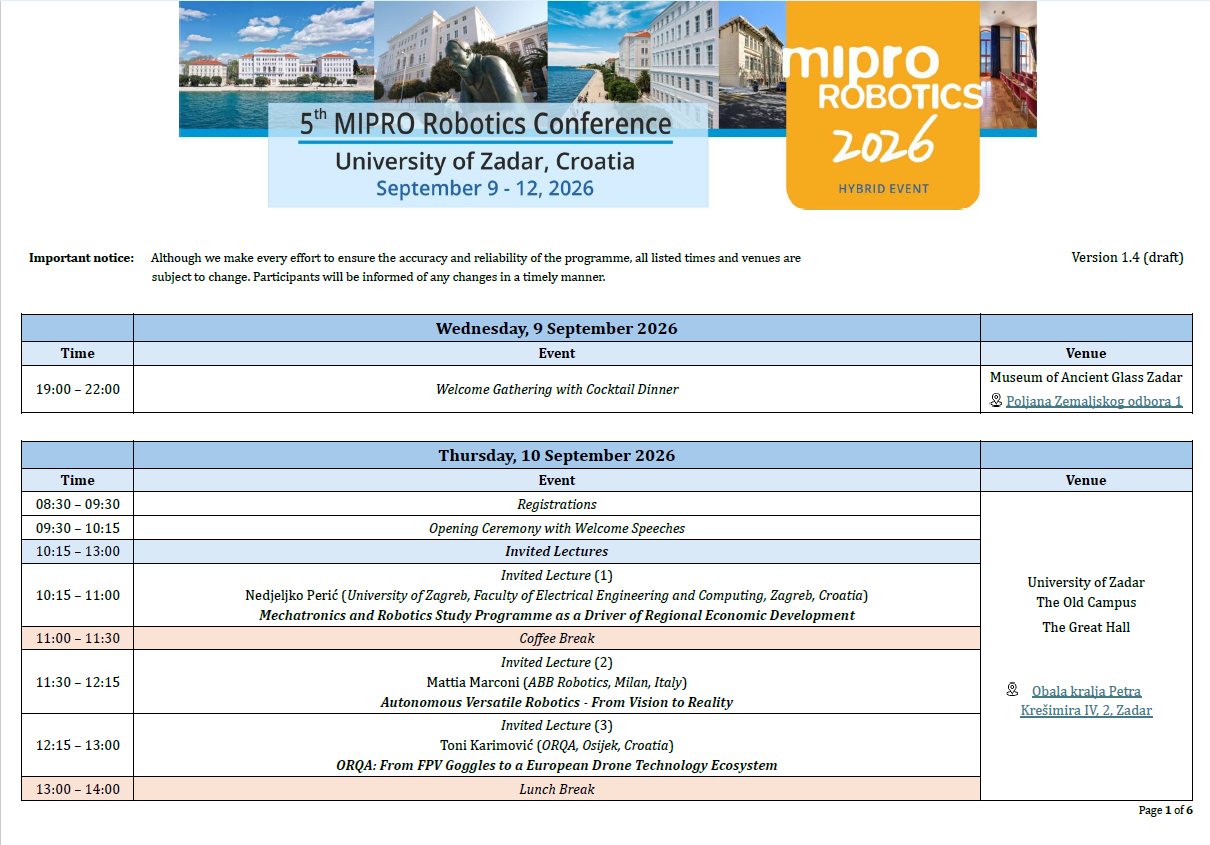
The detailed 4-day programme can be dowloaded HERE.
Basic information:
Chairs:
Marko Valčić (Croatia), Dean Martinović (Croatia), Ive Botunac (Croatia), Martina Grubor (Croatia)
Steering Committee:
Tadej Bajd (Slovenia), Ante Bakić (Croatia), Ricardo Branco (Portugal), Stjepan Bogdan (Croatia), Mario Čelan (Croatia), Bojan Jerbić (Croatia), Ervin Kamenar (Croatia), Zlatko Katalenić (Slovenia), Igor Kotenko (Russia), Zdenko Kovačić (Croatia), Jonatan Lerga (Croatia), Gyula Mester (Hungary), Nikola Mišković (Croatia), Danica Kragić Jensfelt (Sweden), Duc Truong Pham (UK), Vincenzo Piuri (Italy), Ioan Sacala (Romania), Bruno Siciliano (Italy), Karolj Skala (Croatia), Saša Sladić (Austria), Tadej Slapnik (Slovenia), Uroš Janez Stanič (Slovenia), Marko Šarlija (Croatia), Zorislav Šojat (Croatia)
Local Organizing Committee:
Željka Tomasović (Croatia), Mate Barić (Croatia), Marijana Marjanović (Croatia), Mirjana Plečko (Croatia), Željko Goja (Croatia), Draško Stipić (Croatia), Marija Valčić (Croatia)
Registration / Fees:
|
REGISTRATION / FEES
|
Price in EUR
|
EARLY BIRD
Up to September 1, 2026 |
REGULAR
From September 2, 2026 |
| IEEE members |
315 |
360 |
| MIPRO members |
315 |
360 |
| Students (undergraduate and graduate), primary and secondary school teachers |
175 |
200 |
| Others |
350 |
400 |
The student discount doesn't apply to PhD students.
NOTE FOR AUTHORS: In order to have your paper published, it is required that you pay at least one registration fee for each paper. Authors of 2 or more papers are entitled to a 10% discount.
The registration fee is paid by the author participating in the conference. In the case of multiple co-authors, a 10% discount is granted on each subsequent registration fee.
Contact:
Marko Valčić
University of Zadar
Mihovila Pavlinovica 1
HR-23000 Zadar, Croatia
E-mail: mvalcic@unizd.hr
Accepted papers will be published in the ISSN registered conference proceedings. Papers presented at the conference will be submitted for inclusion in the IEEE Xplore Digital Library.

Location:
Zadar, one of the oldest cities on the Adriatic, blends ancient heritage with modern life. Its Roman forum, medieval churches, Venetian fortifications, and iconic Sea Organ attract visitors worldwide. Surrounded by islands and national parks, it offers stunning sunsets and rich cultural experiences.
With top hotels, gastronomy, and festivals, Zadar unites history, innovation, and Mediterranean charm. Today, it is also an emerging hub for congresses, technology, and sustainable development in Southeastern Europe.
For more details, please visit https://zadar.travel/.
|
|